

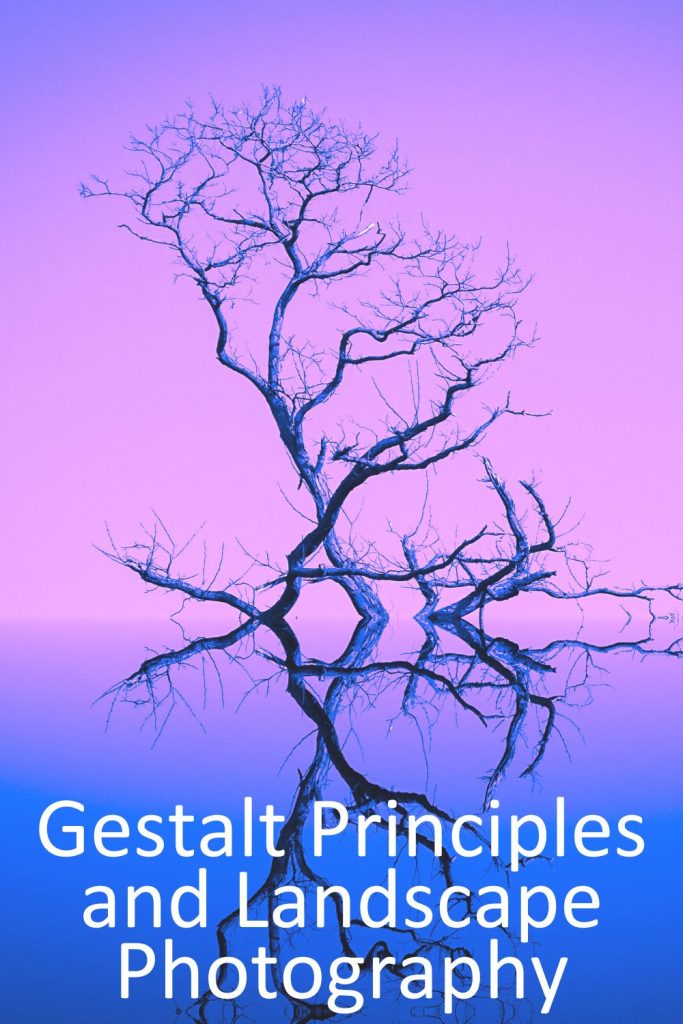
Ever stood in front of a breathtaking landscape, camera in hand, and wondered why certain scenes just click? It’s not just about the golden hour or the rule of thirds.
There’s a fascinating psychological framework at play called Gestalt principles that explains how we perceive visual elements as unified wholes.
Understanding these principles can transform your landscape photography, turning good shots into compelling visual stories.
Why Gestalt Theory Matters to Your Landscape Photography
Gestalt Theory
Gestalt theory comes from early 20th-century psychology and is all about how we naturally organize visual information. Rather than seeing isolated bits and pieces, our brains are wired to group elements into whole forms that make sense. Like seeing a forest instead of just individual trees.
The word “Gestalt” itself is German for “shape” or “form,” and the theory emphasizes that the whole is greater than the sum of its parts. For photographers, this is a game changer.
Humans will naturally attempt to make order out of what might initially appear disconnected and try to “connect the dots”, imposing order on the chaotic.
Instead of thinking only about individual subjects (a mountain, a tree, a cloud) you start to see how all the elements in your frame interact and come together to create a cohesive image.

Discover Your Next Journey – These Tours are designed for people who connect with light and landscape.
Gestalt Principles Quick List
- Proximity
- Similarity
- Figure-Ground
- Continuity
- Closure
- Common Fate
Gestalt Principles in Landscape Photography
When applied to landscape photography, Gestalt principles help explain why some compositions just “feel right.” They give us a language for understanding how viewers instinctively connect with visual elements.
Whether it’s the way lines lead the eye, how we recognize patterns, or how we separate a subject from its background.
These principles don’t just help us create more balanced images, they deepen our ability to communicate mood, movement, and story.
Once you become aware of them, you’ll start to notice them everywhere: in the curve of a shoreline, the spacing of trees in a forest, or even how light and shadow carve a scene into figure and ground.
It’s like seeing the land through a new lens. One that’s both creative and intuitive.
Examples of Gestalt Principles
Proximity: Grouping Elements Naturally
Proximity refers to our tendency to perceive objects that are close to each other as a group.
In landscape photography, this principle helps in composing scenes where elements like trees, rocks, or clouds are positioned close together, creating a sense of unity.
This brings more meaning to the elements than if they were photographs separately.
The opposite is also true: purposely separating elements ensures that they are perceived as distinct from each other and may give them more visual weight. Ensure to balance your scene.

Practical Tip: Fill the Frame
When photographing a cluster of wildflowers/botanicals, getting close and framing them tightly can emphasize their collective beauty, making the image more impactful.
Use a short telephoto zoom such as a 24 – 70mm/24 – 105mm to achieve compression and fill the frame.
Ensure your focal point is where you want it. Use focus stacking to get everything in focus if that is your goal.
Similarity: Creating Harmony Through Repetition
Similarity involves grouping elements that share visual characteristics such as shape, color, or texture. In landscapes, repeating patterns (like rows of crops or similar tree types) can create a harmonious composition.
There is an inherent harmony and calmness when repeating patterns are created.
You can also use this technique to imply relationships between the elements that otherwise may not have been perceived if they had not been grouped together.
Similarity can also be used by capturing an element in the scene that is different than the other similar elements, making it stand out, becoming a target for the viewers eye as it works through the scene.

Practical Tip: Look for repeating elements in nature, such as flowers, sand dunes or waves, and compose your shot to highlight these patterns, enhancing the visual rhythm of your photograph.
Figure-Ground: Defining the Subject
The figure-ground principle is about distinguishing the main subject (figure) from the background (ground). A clear separation helps viewers focus on the intended subject by showing them what you, the photographer, believes is important in the scene.

Practical Tip: Depth of Field
Use depth of field to blur the background, making your subject stand out. For instance, a sharp mountain peak against a soft, cloudy sky draws immediate attention.
Continuity: Leading the Eye
Continuity refers to our preference for continuous lines and patterns. In landscapes, natural lines like rivers or trails can guide the viewer’s eye through the image.
Patterns such as autumn leaves scattered on the ground or rocks along the shoreline can offer continuity to our viewers as well.

Practical Tip: Leading Lines
Incorporate leading lines that draw the eye from the foreground into the scene, creating depth and interest. Leading lines don’t have to be “natural”. You can use roads, fences, walkways, anything in your scene that forms a line.
Closure: Completing the Picture
Closure is our mind’s ability to fill in missing information to perceive a complete image. In photography, this can be used creatively by suggesting shapes or forms without fully defining them.
Our brains will fill in the gaps and provide missing details to create patterns, shapes, etc., adding mystery to our imagery.

Practical Tip: Using your Viewers Imagination
Frame your shot so that elements partially obscure others, prompting viewers to mentally complete the scene, adding intrigue and engagement.
Common Fate: Conveying Movement
Common fate involves perceiving elements moving in the same direction as part of a single group. In still photography, this can be suggested through lines or patterns that imply motion.

Practical Tip: Movement
Capture elements like wind-blown grasses, smooth waterfalls, or migrating birds aligned in the same direction to convey a sense of movement and unity.
Conclusion
Understanding and applying Gestalt principles in landscape photography enriches not only your compositions but also your connection to the natural world.
By recognizing how viewers perceive visual elements, you can craft images that resonate more deeply, telling stories that go beyond the surface.
So next time you’re out with your camera, consider these principles.
Let them guide your eye and your lens, and watch as your photographs transform into compelling narratives of the landscapes you love.