
Learning how to photograph minimalist landscapes with a telephoto lens can completely change the way you see familiar locations.
Rather than asking how much of the landscape you can include, you begin asking how much you can remove.
That shift toward observation and simplicity can turn even complicated landscapes into quiet, deliberate photographs.
How to Photograph Minimalist Landscapes With a Telephoto Lens
Minimalist landscape photography is often associated with wide-open spaces, simple horizons, and lots of negative space, but some of my favorite minimalist compositions are created with a telephoto lens.
Instead of trying to fit an entire landscape into the frame, telephoto landscape photography allows you to select one small relationship within a much larger scene, such as a lone tree against snow, a distant mountain ridge catching light, or repeating layers disappearing into fog.
📸Learn for free!
➡️ FREE Wallpapers and Guides
➡️ DISCOUNTS on future Tours & Tutorials
➡️ TIPS for improving Your photography
You can unsubscribe at anytime.
Why Use a Telephoto Lens for Minimalist Landscape Photography?
Landscape photographers often reach instinctively for a wide-angle lens, but a telephoto lens for landscape photography offers almost the opposite experience.
A wide-angle lens emphasizes space and relationships between foreground and background. A telephoto lens narrows your field of view, allowing you to extract individual compositions from the larger landscape.
Instead of photographing an entire mountain range, you might photograph one illuminated ridge. Instead of including a whole forest, you might isolate three repeating tree trunks.
Long lens landscape photography encourages selection rather than inclusion.

What Makes a Landscape Photograph Minimalist?
Minimalism does not simply mean that a photograph contains very few objects. Strong minimalist composition photography depends on visual clarity. There should usually be one dominant idea.
That might be a shape, subject, line, texture, patch of light, or relationship between colors. Everything else within the frame should support that idea.
This is why minimalist photography techniques are closely connected to subtraction. Before pressing the shutter, look around the edges of the frame and ask whether anything is competing unnecessarily with your main subject.
How Do You Find Minimalist Compositions in a Large Landscape?
One of the easiest ways to begin is to stop looking for complete photographs and start looking for fragments.
Scan slowly across the landscape with your telephoto lens. Look for:
- Repeating mountain ridges
- A lone tree surrounded by open space
- Light illuminating one section of a hillside
- Curves in dunes or snowdrifts
- Small patches of contrasting color
- Patterns created by trees, rocks, or waves
Telephoto nature photography is especially rewarding because these smaller compositions are often invisible until you begin deliberately searching for them.
What Focal Length Works Best for Minimalist Landscape Photography?
There is no single ideal focal length.
| Focal Length | Particularly Useful For |
|---|---|
| 70-100mm | Isolating larger sections of landscapes |
| 100-200mm | Mountains, forests, patterns, and intimate scenes |
| 200-400mm | Distant ridges, isolated details, abstract compositions |
| 400mm+ | Very small details within enormous landscapes |
How Can a Telephoto Lens Help Remove Distractions?
One of the greatest advantages of a telephoto lens is its ability to simplify busy landscapes.
Rather than physically removing distractions, you exclude them through framing. Zoom past an unattractive foreground, eliminate empty sky, avoid roads or buildings, and concentrate only on the strongest portion of the scene.
This makes a 70-200mm lens especially useful for simplifying busy landscapes. A 100-400mm lens gives you even greater ability to find tiny compositions hidden inside distant scenery.
Removing distractions in photography is often less about Photoshop and more about deciding what never enters the frame in the first place.
What Is Telephoto Compression in Landscape Photography?
Telephoto lens compression describes the visual effect where distant elements appear closer together than they would in a wide-angle photograph.
Technically, perspective is determined by your shooting position, but telephoto lenses allow you to frame distant subjects tightly from farther away. The resulting perspective can make mountains, hills, or trees appear stacked closely together.
This apparent compression in landscape photography is especially effective when the landscape already contains repeating layers.
How Can You Use Compression to Create Layered Landscapes?
Photographing mountain layers is one of the classic applications of telephoto landscape photography.
Look for overlapping ridges where each successive layer becomes slightly lighter, softer, or less saturated. Sunrise and sunset can create beautiful separation between these layers, while haze and fog can exaggerate the effect even further.
Layered mountain photography works especially well when you avoid including too much sky or foreground. Filling the frame with repeating ridgelines can transform a recognizable landscape into something much more graphic and abstract.
How Do You Isolate a Strong Subject?
Subject isolation photography begins with identifying the element carrying the greatest visual weight.
A dark tree against bright snow immediately attracts attention. So does an illuminated mountain peak surrounded by shadow or a single patch of vegetation among pale desert dunes.
Once you identify that subject, use your focal length to remove competing elements.
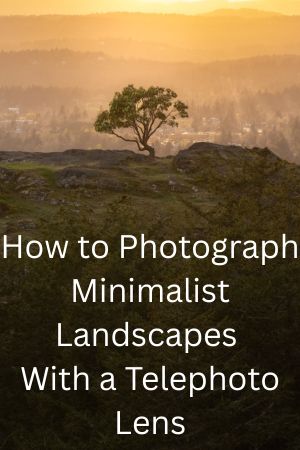
Lone tree landscape photography is a perfect example. The tree itself may occupy only a small portion of the frame, yet its tonal contrast and isolation can make it visually dominant.
Why Is Negative Space Important in Telephoto Landscapes?
Negative space landscape photography gives isolated subjects room to breathe.
Snow, fog, water, desert, and open sky can all become effective negative space. Rather than treating these areas as empty, consider them active parts of the composition.
A tiny dark tree surrounded by a large expanse of snow may feel balanced precisely because the surrounding space is so quiet.
Visual weight matters here. A small dark object can balance a surprisingly large bright area because our eyes are naturally drawn toward contrast.
How Can Contrast Make a Minimalist Composition Stronger?
Contrast in minimalist photography helps establish a clear visual hierarchy.
You might use tonal contrast between bright snow and dark trees, color contrast between warm sunlight and cool shadows, or textural contrast between smooth water and rugged rock.
The contrast does not need to be dramatic. Sometimes a slightly darker mountain ridge emerging through fog is enough to anchor the entire image.
The simpler the composition becomes, the more important these subtle relationships become.
How Do Fog, Mist, and Haze Help Simplify a Landscape?
Telephoto photography in fog can transform complicated scenery into beautifully simple compositions.
Fog hides distracting details, separates overlapping subjects, and creates atmospheric depth. Mountains may gradually fade from dark foreground layers into nearly invisible distant shapes.
Foggy minimalist landscape photography also introduces an element of mystery. Within the symbolism of the four elements, mist belongs naturally to Air and Water, softening boundaries and reminding us that landscapes are rarely as fixed or separate as they first appear.
How Can You Create Abstract Landscapes With a Telephoto Lens?
Abstract telephoto landscape photography begins when you stop asking what the subject is and begin noticing what it looks like.
A mountain becomes a triangle of light. Sand dunes become curves. Forests become patterns of vertical lines. Snow becomes alternating shapes of white and shadow.
Look for rhythm, repetition, texture, tonal contrast, and color blocking.
These intimate landscapes with a telephoto lens can be especially satisfying because they are rarely tied to a famous viewpoint. They become personal interpretations of the landscape rather than records of a location.
Landscape photography with a 70-200mm lens is an excellent starting point because the range is versatile without becoming overly restrictive.
What Camera Settings Should You Use With a Telephoto Lens?
For stationary landscapes, ISO 100 and an aperture around f/8 to f/11 provide a useful starting point, but your settings should always respond to the scene rather than follow a formula.
Pay particular attention to shutter speed telephoto photography. Longer focal lengths magnify camera movement, so a shutter speed that works handheld with a wide-angle lens may produce softness with a 300mm or 400mm lens.
Image stabilization can help, but it cannot compensate for every situation.
Do You Need a Tripod for Telephoto Landscape Photography?
A tripod is not mandatory, but it can be extremely useful.
A tripod for telephoto landscape photography provides stability in low light while also encouraging slower, more deliberate composition. Small framing changes become important when you’re working with minimalist scenes, and a tripod allows you to refine those relationships carefully.
If you’re photographing distant mountain layers at sunrise or working with slower shutter speeds, I would usually choose the tripod.
What Common Mistakes Make Telephoto Landscapes Feel Cluttered?
The most common mistake is simply including too much.
Zooming in does not automatically create minimalism. Carefully inspect the frame for branches, bright highlights, intersecting lines, patches of sky, or partial objects around the edges.
Another mistake is assuming every empty area is useful negative space. Space should support the subject and visual balance rather than merely occupy part of the frame.
Minimalist landscape photography is intentional simplicity, not emptiness for its own sake.
How Can You Train Yourself to See Smaller Landscapes Within the Larger Scene?
Mindful landscape photography works particularly well with telephoto lenses because they encourage you to slow down and scan.
Instead of immediately photographing the obvious view, spend several minutes observing. Follow the light. Look at relationships between distant shapes. Notice where one ridge overlaps another or where a single tree separates cleanly from its background.
Photography as observation becomes especially important here. The compositions already exist within the larger landscape. Your task is learning to recognize them.
Conclusion
Learning how to photograph minimalist landscapes with a telephoto lens changes landscape photography from an exercise in fitting everything into the frame to one of careful selection.
By isolating subjects, using negative space, exploring compression, and eliminating distractions, you can discover simple landscape compositions hidden inside locations that initially appear overwhelmingly complex.
- How to Photograph Minimalist Landscapes With a Telephoto Lens
- Why Use a Telephoto Lens for Minimalist Landscape Photography?
- What Makes a Landscape Photograph Minimalist?
- How Do You Find Minimalist Compositions in a Large Landscape?
- What Focal Length Works Best for Minimalist Landscape Photography?
- How Can a Telephoto Lens Help Remove Distractions?
- What Is Telephoto Compression in Landscape Photography?
- How Can You Use Compression to Create Layered Landscapes?
- How Do You Isolate a Strong Subject?
- Why Is Negative Space Important in Telephoto Landscapes?
- How Can Contrast Make a Minimalist Composition Stronger?
- How Do Fog, Mist, and Haze Help Simplify a Landscape?
- How Can You Create Abstract Landscapes With a Telephoto Lens?
- What Camera Settings Should You Use With a Telephoto Lens?
- Do You Need a Tripod for Telephoto Landscape Photography?
- What Common Mistakes Make Telephoto Landscapes Feel Cluttered?
- How Can You Train Yourself to See Smaller Landscapes Within the Larger Scene?
- Conclusion
- FAQ
- References
- 📸Learn for free!
FAQ
Is a 70-200mm Lens Good for Minimalist Landscape Photography?
Yes. A 70-200mm lens is extremely versatile for isolating subjects, removing distractions, photographing mountain layers, and finding intimate compositions within larger landscapes.
Is 400mm Too Long for Landscape Photography?
Not at all. A 100-400mm lens can reveal distant landscape details, patterns, mountain ridges, trees, and abstract compositions that would barely be visible with a wider lens.
Why Do Telephoto Landscapes Look Compressed?
Telephoto photographs are commonly associated with compression because photographers usually shoot distant subjects from farther away. That perspective causes foreground and background elements to appear closer together.
What Subjects Work Best for Minimalist Telephoto Photography?
Lone trees, mountain ridges, dunes, snowdrifts, foggy forests, illuminated peaks, repeating patterns, distant buildings, shorelines, and isolated patches of color all work particularly well.
References
- Freeman, Michael. The Photographer’s Eye.
- duChemin, David. The Visual Toolbox: 60 Lessons for Stronger Photographs.
- Peterson, Bryan. Learning to See Creatively.